
What Is Forecasting?

Every decision you make is a forecast. When you grab an umbrella before leaving home, you’re forecasting rain. When a company orders extra inventory before the holidays, it’s forecasting demand. When a government adjusts interest rates, it’s forecasting inflation.
Forecasting is the art and science of making informed predictions about the future using available information.
That’s it. No complex formulas needed to understand the concept. But beneath this simple definition lies a discipline that powers trillion-dollar decisions every day.
Why Forecasting Matters
Consider these numbers
- A 1% improvement in demand forecasting can save a retailer $10 million annually in reduced waste and stockouts
- Airlines use forecasting to set prices for over 3 billion passenger trips each year
- Energy grids forecast power demand every 15 minutes to keep the lights on
- Central banks forecast GDP and inflation to set policies that affect billions of people
Forecasting isn’t an academic exercise. It’s the invisible engine behind modern economies. Every supply chain, every financial market, every hospital staffing plan relies on some form of prediction.
“Prediction is very difficult, especially about the future.” — Niels Bohr
Bohr was right — but we don’t need perfect predictions. We need predictions that are good enough to make better decisions than guessing.
The Two Camps: Qualitative vs. Quantitative
Broadly, forecasting approaches fall into two camps.
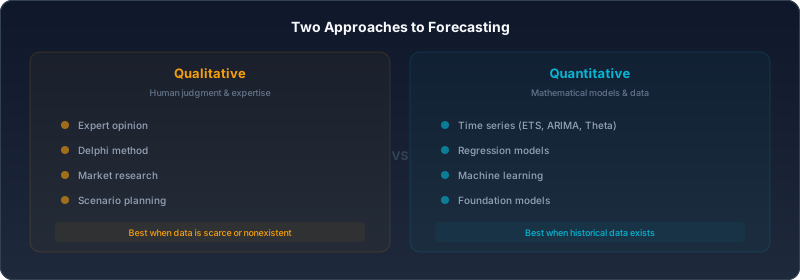
Qualitative Forecasting
This relies on human judgment, expertise, and intuition. Examples include
- Expert opinion: A seasoned retail buyer predicting next season’s trends
- Delphi method: A panel of experts iteratively refining their predictions
- Market research: Surveys and focus groups gauging consumer intent
- Scenario planning: “What if oil prices double? What if a new competitor enters?”
Qualitative methods shine when data is scarce or nonexistent — launching a brand-new product, entering an unknown market, or predicting the impact of unprecedented events.
Quantitative Forecasting
This uses mathematical models applied to historical data. This is where tools like Vectrix live. Examples include
- Time series models: Analyzing patterns in sequential data (ETS, ARIMA, Theta)
- Regression models: Finding relationships between variables (“sales increase by X when temperature rises by Y”)
- Machine learning: Neural networks, gradient boosting, and ensemble methods
- Foundation models: Pre-trained deep learning models that generalize across datasets
Quantitative methods shine when historical data exists and the future somewhat resembles the past.
In practice, the best forecasters combine both. Numbers inform judgment; judgment corrects numbers.
The Three Patterns Every Forecaster Must Know
When you look at any time series data, you’re looking for three fundamental patterns
1. Trend
Is the data going up, going down, or staying flat over time?
A company’s revenue growing 10% year-over-year has an upward trend. A declining population in a rural town shows a downward trend. A stable utility bill shows no trend.
Trend tells you the direction. It’s the “big picture” of your data.
2. Seasonality
Are there repeating patterns at regular intervals?
Ice cream sales peak every summer. E-commerce traffic spikes every Black Friday. Hospital admissions rise every flu season. These are seasonal patterns — they repeat at predictable intervals.
Seasonality can be
- Daily: Restaurant traffic peaks at lunch and dinner
- Weekly: Gym attendance drops on weekends
- Monthly: Rent payments on the 1st of each month
- Yearly: Holiday shopping in December
3. Noise
Everything that isn’t trend or seasonality is noise — random fluctuations that can’t be predicted.
A sudden spike in website traffic because a celebrity mentioned your product. An unexpected dip in sales because a water main broke outside your store. These are random events that no model can foresee.
The goal of forecasting is to capture the signal (trend + seasonality) and accept the noise as irreducible uncertainty.
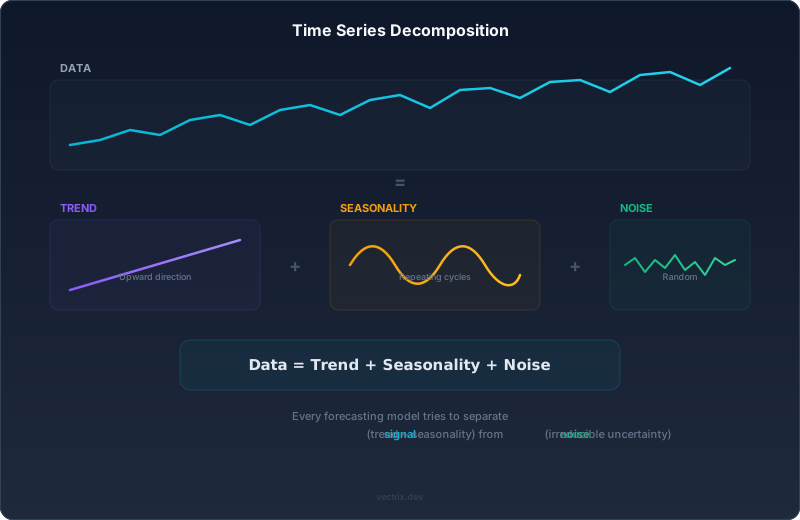
That’s the fundamental equation. Every forecasting model, from the simplest to the most complex, is trying to separate signal from noise.
How Forecasting Actually Works (The 10,000-Foot View)
Here’s the process, stripped to its essence
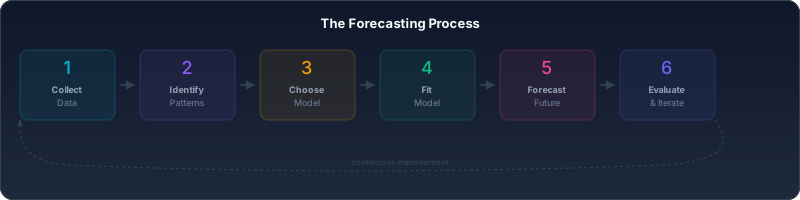
Step 1: Collect historical data. You need past observations. Monthly sales for the last 3 years. Daily temperatures for the last decade. Hourly website traffic for the last quarter. More data usually means better forecasts — but not always.
Step 2: Identify patterns. Look for the three patterns: trend, seasonality, and noise. Is there a clear direction? Are there repeating cycles? How “noisy” is the data?
Step 3: Choose a model. Select a mathematical model that can capture the patterns you’ve identified. Simple data might need a simple model. Complex data might need a sophisticated one. The best model is the simplest one that captures the patterns adequately.
Step 4: Fit the model. Feed your historical data into the model. The model “learns” the patterns — estimating trend slopes, seasonal factors, and noise levels.
Step 5: Generate forecasts. Use the fitted model to project into the future. The model extrapolates the learned patterns forward.
Step 6: Quantify uncertainty. Every forecast is uncertain. Good forecasters don’t just give a number — they give a range. “We expect 1,000 units, but it could be anywhere from 800 to 1,200.”
Step 7: Evaluate and iterate. Compare your forecasts against what actually happened. Learn from errors. Adjust. Repeat.
The Honest Truth About Forecasting
Let’s be upfront about what forecasting can and cannot do.
Forecasting CAN
- Identify likely ranges for future values
- Detect and extrapolate existing patterns
- Quantify the uncertainty in predictions
- Provide a disciplined framework for decision-making
- Improve consistently with better data and methods
Forecasting CANNOT
- Predict black swan events (pandemics, wars, market crashes)
- Guarantee accuracy — all forecasts are wrong, some are useful
- Replace domain expertise and human judgment
- Work well without sufficient historical data
- Predict the future when the future is fundamentally different from the past
The legendary statistician George Box said it best
“All models are wrong, but some are useful.”
The goal isn’t perfection. The goal is to be less wrong than the alternative — which is often gut feeling, wishful thinking, or no plan at all.
What’s Next?
This post covered the “what” and “why” of forecasting. In upcoming posts, we’ll dive deeper
- How Do We Know If a Forecast Is Any Good? — Benchmarks, metrics, and the M Competitions
- Python Forecasting Libraries Compared — Which tool should you use?
- Your First Forecast in Python — From data to prediction in 15 minutes
- Time Series Models Explained — ETS, ARIMA, Theta, and when to use each
Forecasting is a journey from intuition to evidence. Welcome aboard.
Want to try forecasting right now? Install Vectrix and run your first forecast in one line of code.